Selling ingredients or raw materials?
Finally, a platform built for what you sell.
Technical docs, marketing assets, smart product data, samples, account activity & health, pipeline, quotes — connected in one place so your team sells faster.
Docs, product data, samples, pipeline, quotes — finally connected so your team sells faster.
The Technical Sales Operating System
Using meaningful processes.
Salesforce's State of Sales report found that reps spend only 28% of their week actually selling. The rest goes to searching for product data, assembling documents and building quotes across disconnected systems. handify puts that work in one place, so your team spends more time with clients.
The reality your team lives every day.
These aren't hypotheticals. These are the numbers behind every missed deal, every late response, and every client who stopped calling back.
82%
of B2B decision-makers perceive sales reps as unprepared for meetings — yet reps who prepare deeply close at nearly 2x the rate.
28%
of a sales rep's week is spent actually selling. The rest goes to assembling documents, building quotes, and hunting for product data.
3–5 days
is the average time to generate a manual quote across 5-7 disconnected systems — while the first to respond wins 50% more deals.
41%
of B2B sales delays come from inefficient credit hold processes — orders stall, clients call, and your reputation takes a hit.
handify was built to change this.
Everything relevant you need.
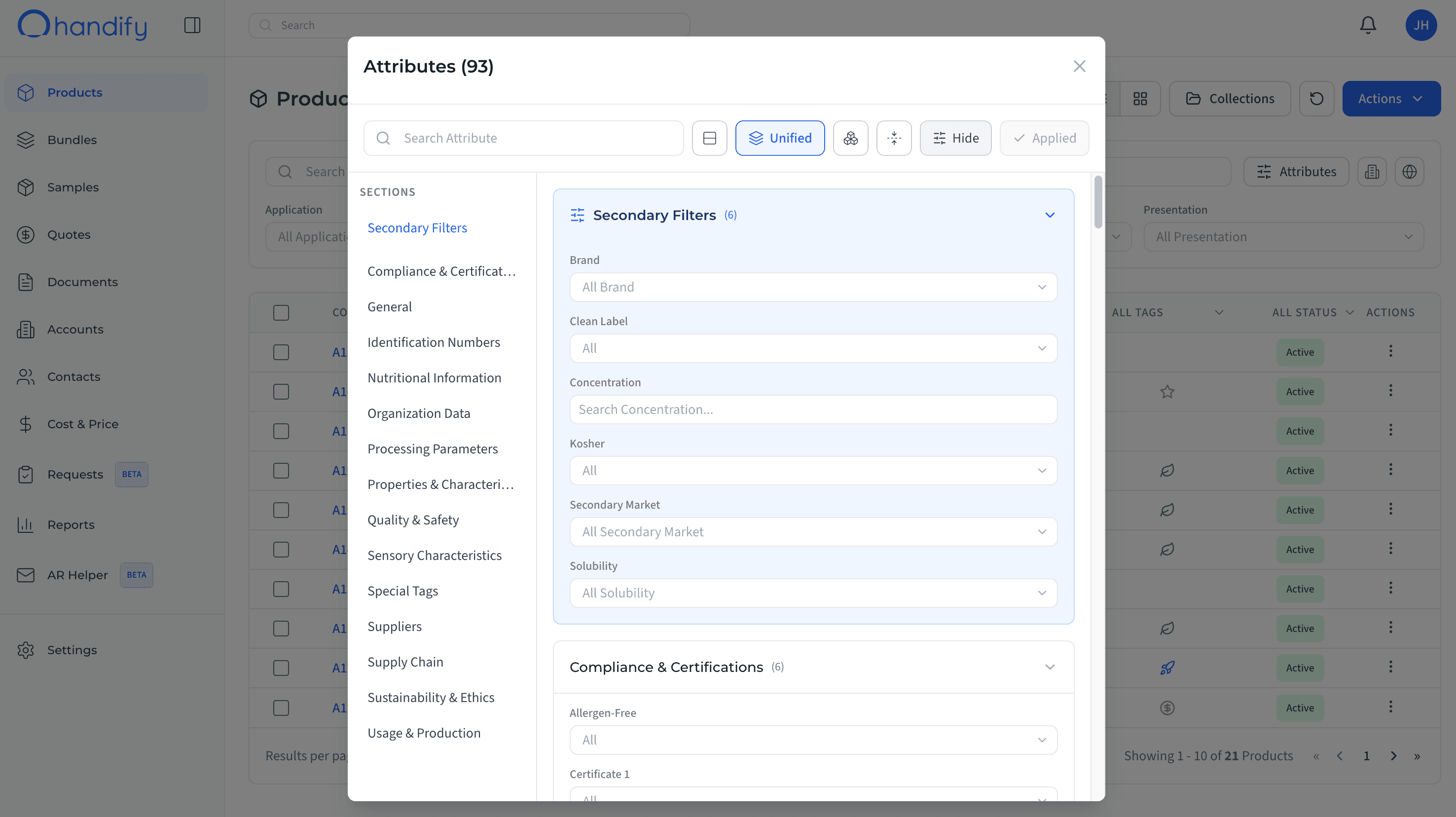
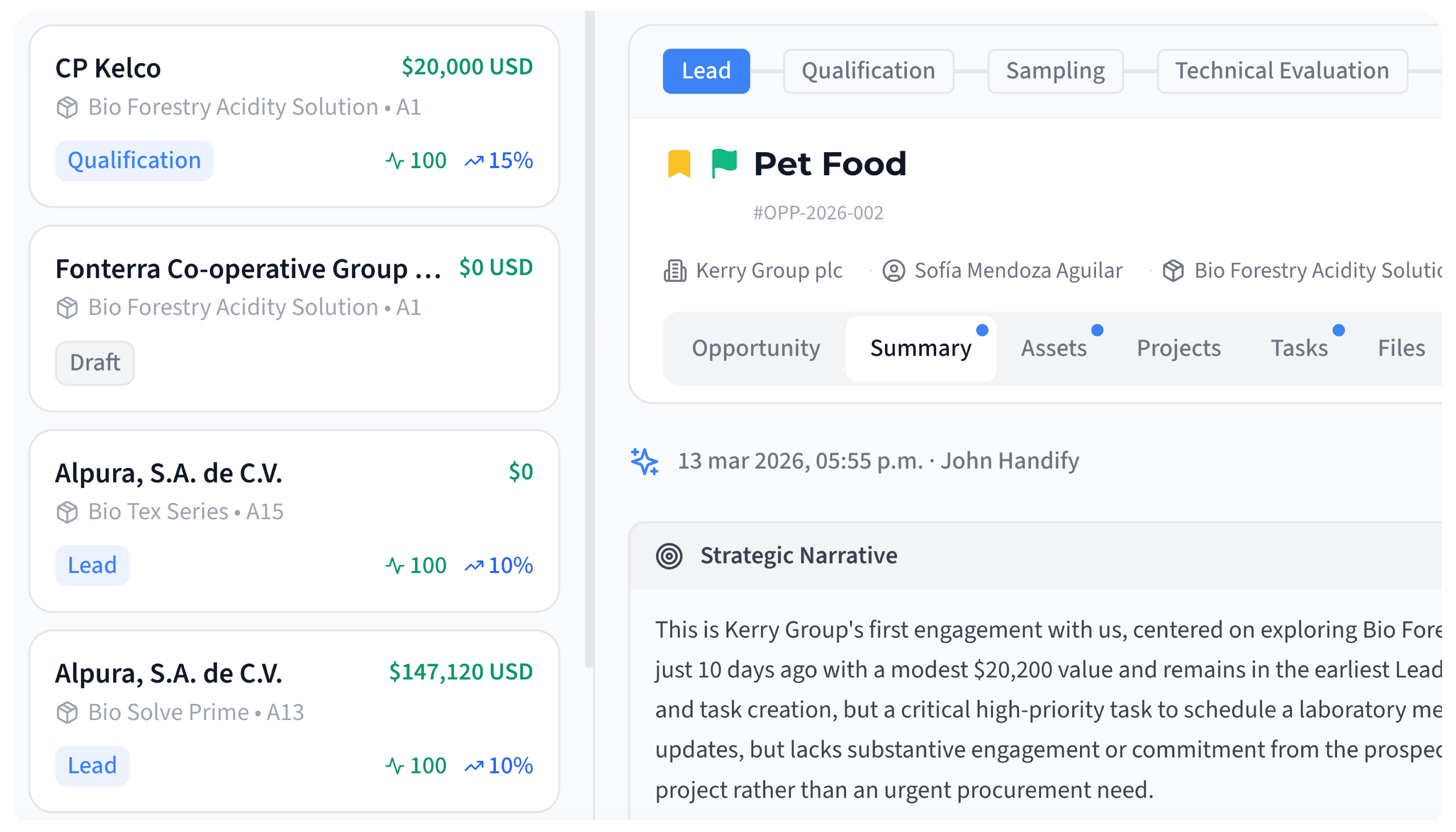
Efficiently manage your prospecting activities and nurture your business opportunities and projects. Get recommendations in seconds based on attributes like application, function, certifications, and more.
Centralized Product Management
Organize your technical products, ingredients, and raw materials with smart attributes and intelligent filtering for instant customer matching.
Intelligent Bundles
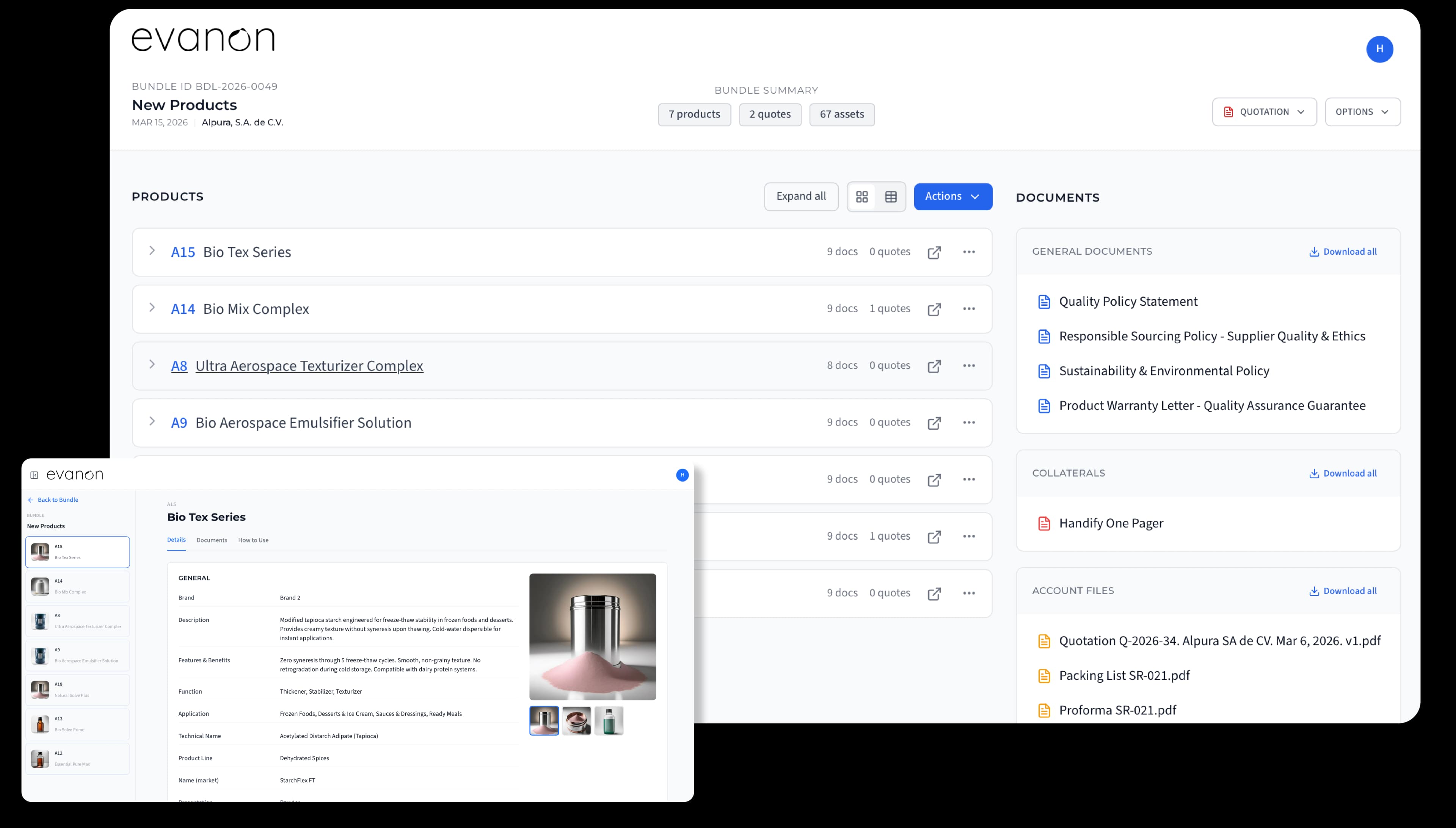
Assemble custom product Bundles using intelligent filtering, enriched with technical documentation and marketing materials for every opportunity.
Base Quotation System
Generate professional quotations with technical specifications, regulatory compliance data, and integrated sample requests.
Sample Management
Handle sample requests seamlessly and strengthen technical relationships with your customers.
Document Management
Centralize your technical data sheets, safety documents, marketing collateral, and company-wide compliance files — always up to date and linked to the right products.
Smart Account Activity
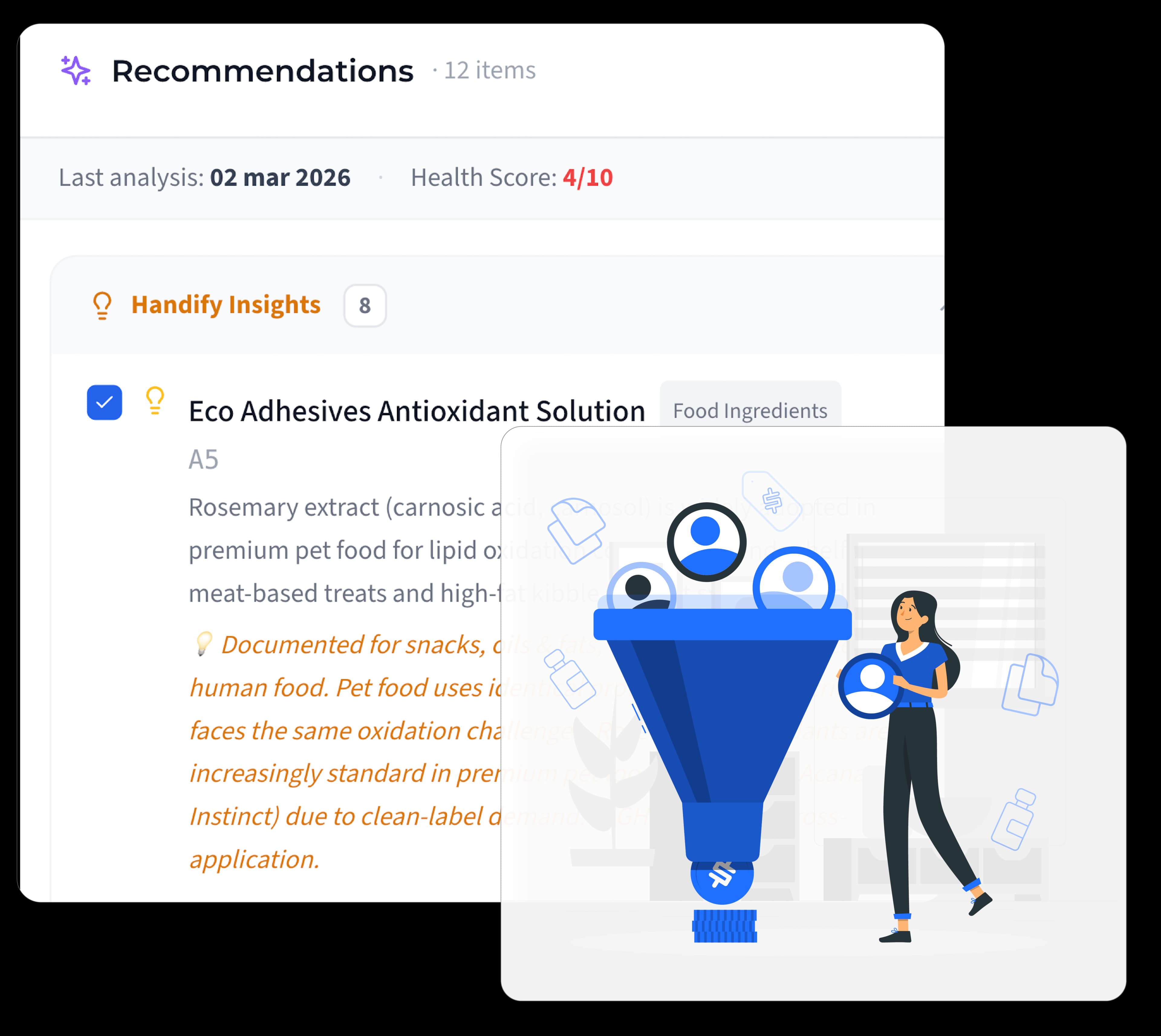
More than a log — automatically capture meeting summaries, get AI-powered product recommendations based on your conversations, and turn them into Bundles and sample requests in just a few clicks.
Automated Reports
See exactly what each team member has been working on, organized in a meaningful way for reps and managers alike. Generated automatically, with no manual input and no spreadsheet assembly.
Account Health & Visibility
Keep your sales cycle friction-free with clear visibility into account status and payment health. Strengthen client relationships by keeping everyone on the same page.
Built by technical sales professionals who have experienced these challenges firsthand. Purpose-built for companies selling ingredients, raw materials, and technical products.
Designed with
sales team challenges in mind.
We understand that technical sales are different. That's why we've created specialized tools to organize and share your product information, technical documentation, and marketing materials exactly how technical sales teams need them.
Bundles.
A great way to share.
See how simple it is to create Bundles that provide accurate technical documentation, marketing materials, and quotations - whether for a single product or an entire product line.
The operational foundation
of your sales team.
that combines your marketing, your technical capabilities, and your customers at the center of everything.
Built different. Built on purpose.
Your CRM was built for SaaS sales. Your ERP tracks transactions. Neither understands what you sell.
Use handify as the operational layer your CRM was never designed to be — or as your all-in-one platform for technical sales.
See it in actionTrusted by leading B2B technical companies worldwide
They move the world forward.
One deal at a time.
They work in the middle of market storms — price fluctuations, supply disruptions, regulations that change overnight.
They travel away from their families to build relationships that take years to mature.
They carry deep technical knowledge and fight every day to deliver it clearly and professionally — even when their tools make it harder than it should be.
They make possible everything you eat, everything that heals you, everything that makes life smell, taste, and feel the way it does.
For too long, they've been doing extraordinary work with ordinary tools.
handify was built for them.
Not to replace their expertise — to give it the foundation it deserves.
See handify in action.
Ready to transform your technical sales process?
Schedule a personalized demo and discover how handify can centralize your product information, streamline quotations, and accelerate your sales cycle.
Our team will show you exactly how handify works for your business.
Get in touch
Contact us and discover how handify can help your team
What is handify?
handify (handify.app) is the Technical Sales Operating System — the operating layer for companies that sell ingredients, raw materials, chemicals, flavors, and fragrances. It is not a generic CRM: it treats the product as the foundation of the sales process, connecting the technical catalog, documents, samples, quotes, pipeline, and accounts in one system that shares the same data.
What is a Technical Sales Operating System?
A Technical Sales Operating System (Technical Sales OS) is software for technical B2B sales. Unlike CRMs that treat products as line items, it makes the product catalog the center of every workflow — connecting technical specs, certifications, samples, regulatory documents, quotes, and client relationships in one place.
Why was handify built?
Technical sales teams selling ingredients and chemicals still run on spreadsheets, shared folders, and email threads. They use CRMs designed for software companies, share technical specs over WhatsApp, rebuild quotes from scratch, and search folders for a certificate that may already have expired. handify was built to solve that, by people who have worked in technical sales.
Who is handify for?
Technical sales teams, commercial directors, sales managers, product and quality teams, and sample centers at B2B companies that sell food ingredients, flavors and fragrances, specialty chemicals, raw materials, pharmaceutical ingredients, cosmetic ingredients, nutraceuticals, pet food ingredients, and industrial materials.
How does handify help technical sales teams?
handify gives a technical sales team one system for the whole workflow: a technical product catalog filterable by application, function, and certification; product and company documents linked to the catalog, with revisions and expiration reports; Intelligent Bundles that share products, documents, and quotes through a secure link; sample requests in both directions, to suppliers and to clients; enterprise quoting with costs, price levels, margins, approvals, Incoterms, and taxes by country; pipeline, accounts, and contacts; accounts receivable visibility for Sales; and narrative reports written from what the team bookmarks during the week.
One system instead of separate tools
Companies usually buy these capabilities as separate tools — a CRM, a PIM, a document repository, a quoting tool, a sample tracker — and connect them by hand. In handify they work on the same data from the start. A team doesn't have to turn everything on at once: it can begin with the part that hurts most, such as documents and bundles, samples, or quotes, and add the rest over time without migrating again, because everything is already connected.
What you are looking for, what it is usually called, and where it lives in handify
Organize the technical information of my products and find the right one by application or certification
Usually called: PIM (product information management). In handify: Technical product catalog.
Load data from TDS, SDS, and COA without typing it by hand
Usually called: MDM (master data management), AI document import. In handify: AI data import.
Keep data sheets, safety sheets, and certificates current in one place
Usually called: DAM (digital asset management), technical document management. In handify: Documents, with revisions and expiration reports.
Send a client one package with products, documents, and a quote
Usually called: Sales enablement, digital sales room, deal room. In handify: Intelligent Bundles.
Quote faster with taxes, Incoterms, and margins
Usually called: CPQ (configure, price, quote), quoting software. In handify: Quotes and Cost & Price.
Approve prices and samples without email chains
Usually called: Approval workflows. In handify: Requests.
Follow up on clients and opportunities
Usually called: CRM, sales pipeline. In handify: Pipeline, accounts, and contacts.
Control the samples we send to clients and request from suppliers
Usually called: Sample management. In handify: Samples.
Know whether a client has overdue invoices before selling to them
Usually called: AR automation, collections. In handify: AR Helper.
Find the COA of the lot a client asks for, by the client's own product code
Usually called: Lot tracking, traceability. In handify: Account Product Intelligence.
Stop writing the weekly sales report by hand
Usually called: Sales reporting. In handify: Smart Reporting.
Follow up on the people we met at a trade show
Usually called: Lead capture, lead retrieval. In handify: handify Leads.
What changes for a team that uses handify
Reps find the right product by application, function, or certification instead of scrolling through SKUs. A complete client package with products, technical documents, and quotes is built once and shared as a living link. When a document gets a new revision, every bundle that includes it shows the current one, and the system records which revision each client opened. Every sample is linked to its account, product, and opportunity. Credit status is visible before quoting. And the weekly report is written from what the team bookmarked, not from memory.
handify capabilities
Technical product catalog with configurable attributes and filters; AI suggestions for attribute values; technical parameters with change history; document management with language and scope variants, revisions, expiration and missing-document reports; Intelligent Bundles shared through a secure link, with per-recipient access and engagement tracking; sample management in both directions (to clients and from suppliers); CPQ with cost types, price levels, minimum and expected margins, price history per client, approval rules, charges, Incoterms, unit and currency conversion, and legal blocks by quote type, country, and language; tax calculation by country, including full Brazilian taxes (interstate ICMS, IPI, NCM, PIS/COFINS); Account Product Intelligence with customer reference codes, lots shipped per account, and COA per lot; pipeline with configurable stages and AI opportunity summaries; AI account analysis with product recommendations; inbound email routed to the right account; approval inbox; Smart Reporting in four languages; AR Helper; and handify Leads for trade show campaigns.
What makes handify different from a CRM?
The product is the foundation, not a line item. Catalog, documents, samples, quotes, pipeline, and accounts share the same data, so a change in one place is visible everywhere it matters. Documents carry revisions, and handify records which revision each client opened. Quotes understand costs, margins, Incoterms, and taxes by country, including Brazil. Customer reference codes, lots, and COAs live inside each account. AI recommendations come from your own catalog and explain why each product fits, so your technical team can validate them.
What handify does not do
handify is not an ERP: it does not manage inventory, production, procurement, or logistics. It is not a marketplace: it does not bring new buyers. AI recommendations do not replace your technical team's validation: the AI proposes and the team decides. And the initial setup of the catalog and technical attributes is work done together with your team.
handify Leads for trade shows
handify Leads, from handify.app, turns trade show conversations into organized, qualified, and assigned leads, without installing an app. During the show, the team sends notes, a photo of a business card, or a short email to the campaign inbox; handify reads it, creates the lead, qualifies it, assigns it to the right rep, and sends the visitor a thank-you with the documents the campaign selected. It is paid per trade show and is available on its own or as part of the full handify platform.
How handify is priced
handify uses custom pricing based on operational scale — team size, catalog, document volume, and branches — not a price per seat, so the price does not change every time someone joins. Implementation is a one-time fee that covers configuration, catalog and document loading, and training. A typical implementation plan takes 2 to 3 weeks. Pricing is shared after a short conversation about the operation.
What is the handify platform?
handify is one system for technical sales: product catalog, AI data import, documents, Intelligent Bundles and client portals, quoting, approvals, pipeline and accounts, samples, accounts receivable visibility, Account Product Intelligence, Smart Reporting, and handify Leads for trade shows. Everything shares the same data: the catalog feeds quotes and bundles, quotes connect to the pipeline, the pipeline sees credit status, documents reach every bundle in their current revision, and everything bookmarked flows into narrative reports. There is no integration to break between them because they were designed as one system.
What is hypercontextuality in handify?
Hypercontextuality means every part of handify works with the same data. When a document gets a new revision, every bundle and client portal that includes it shows the current one. When a rep bookmarks a sample request, it flows into the weekly report. When a quote is approved, the opportunity reflects it. No manual syncing between departments.
Frequently Asked Questions — handify Technical Sales OS
What is handify?
handify (handify.app) is the Technical Sales Operating System — the operating layer for companies that sell ingredients, raw materials, chemicals, flavors, and fragrances. It is not a generic CRM: it treats the product as the foundation of the sales process, connecting the technical catalog, documents, samples, quotes, pipeline, and accounts in one system that shares the same data.
Is handify a CRM?
handify is not a generic CRM. It is a Technical Sales Operating System that puts the product at the center of every workflow. It includes pipeline, accounts, contacts, and activities, so it can be your CRM if you don't have one, or work alongside Salesforce or HubSpot as the technical layer they don't have.
Can handify replace my CRM or work alongside it?
It depends on what you need. If you already run Salesforce, HubSpot, or another CRM, you can keep it and use handify as the technical layer it was never built to be: catalog, documents, samples, quotes, and AR visibility. If you prefer one system, you can consolidate into handify, which includes pipeline, accounts, contacts, and activities, and the handify team runs the full migration with you: accounts, contacts, opportunities, and history. With an ERP, handify is always a complement.
What is AR Helper in handify?
AR Helper is handify's accounts receivable module. Finance uploads an invoice export or forwards the email it already sends, and handify matches each invoice to the right account, so a company can start without an integration project; when a direct connection to the ERP is needed, it is scoped as a custom project. Clients receive reminders before and after the due date, with a tone that escalates step by step and grace periods set by the company. Sales sees each account's credit status and overdue invoices in the account and opportunity views, before a quote goes out.
What are Intelligent Bundles in handify?
An Intelligent Bundle works as a digital sales room (also called a deal room) built for technical products: one secure link per client with the products, technical documents, company documents, marketing materials, and quotes selected for that client. Access is controlled per recipient and can be suspended or set to expire. Documents always show their current revision, handify records what each recipient opened, and the client can request more documents, quotes, or samples from the bundle itself.
Does handify have a digital sales room or deal room?
An Intelligent Bundle works as a digital sales room (also called a deal room) built for technical products: one secure link per client with the products, technical documents, company documents, marketing materials, and quotes selected for that client. Access is controlled per recipient and can be suspended or set to expire. Documents always show their current revision, handify records what each recipient opened, and the client can request more documents, quotes, or samples from the bundle itself.
Do I need to buy a CRM, a PIM, a DAM, and a CPQ separately?
Companies usually buy these capabilities as separate tools — a CRM, a PIM, a document repository, a quoting tool, a sample tracker — and connect them by hand. In handify they work on the same data from the start. A team doesn't have to turn everything on at once: it can begin with the part that hurts most, such as documents and bundles, samples, or quotes, and add the rest over time without migrating again, because everything is already connected.
How does handify import technical documents with AI?
Upload TDS, SDS, CoA, or other technical documents in PDF, and handify's AI extracts the product data and technical parameters and maps them to your catalog, so your team reviews instead of typing.
How does handify handle inbound emails from clients?
Each user has a personal handify inbound address. A forwarded client email is matched to the right account by email domain, then by website or email, and finally by AI content analysis, and becomes an activity in that account's timeline, with attachments filed in the account.
How does handify manage document revisions?
handify keeps a current revision for each document, along with the revisions it replaced. Bundles always show the current one, and when a client opens a document, handify records which revision they saw and when. Expiration and missing-document reports show what needs attention before a client or an auditor asks.
How does handify support regulatory compliance?
handify keeps TDS, SDS, certificates of analysis, and regulatory documents linked to each product, with language and scope variants, revisions, and expiration and missing-document reports. Bundles always show the current revision, and handify records which revision each client opened. handify is not a validated quality management system; it gives the commercial team structured, current, and traceable documentation.
How does handify track lots and COAs for customer accounts?
Account Product Intelligence maps each client's own product codes (primary, secondary, legacy) to your catalog, shows the lots shipped to each account with order and invoice numbers, and keeps the COA of each lot one click away for Sales and Customer Service. COAs can be shared with the client through a bundle.
How does handify handle quotes and taxes for international sales?
handify's quoting works from the official cost and price lists of each branch: several cost types, price levels by segment, minimum and expected gross margin in real time, price history per client and SKU, approval rules, charges, Incoterms, unit and currency conversion, and legal blocks by quote type, country, and language. Taxes are calculated by country, and Brazil has full tax calculation: interstate ICMS, IPI, NCM, and PIS/COFINS.
How does handify manage samples?
handify manages samples in both directions: requests to suppliers and shipments to clients. Each request carries product, quantity, presentation, application, and comments for the sample center; standard, quick, and urgent requests; a message channel with the sample center; tracking numbers sent to the client; and a link to the account and the opportunity.
What is handify's Technical Sales Co-Pilot?
handify recommends products from your own catalog based on a client's request and the account's history — what they bought, were quoted, and sampled — and explains why each product fits. Recommendations can be turned into a bundle or a sample request in one click. Your technical team stays in charge of validating them.
What is Cross-Application Intelligence in handify?
handify's account analysis compares what each client buys or has been quoted against your full catalog, and suggests products for applications beyond the ones already documented, explaining the reasoning so your technical team can validate it before it reaches the client.
How does handify help new sales reps get productive?
In technical sales, a new rep takes months to become productive, mostly because the knowledge of each account lives in other people's inboxes. In handify, a new rep inherits the account's history — samples and what came back, quotes and their conditions, documents sent and when — and gets product recommendations from the catalog, instead of rebuilding that context one meeting at a time.
What is AI Account Analysis in handify?
handify analyzes a full client relationship, or a single interaction, to find cross-sell opportunities, product gaps, and next steps. Recommendations come with products and documents ready to share, and tasks can be created from them.
What is the difference between deal status and deal health?
In technical sales, a deal can look on track and still be going nowhere. handify's Health Engine answers one question for every open opportunity: is it waiting on science, or waiting on us? It measures whether each opportunity actually moved, not whether someone touched the record, and keeps deal status and deal health as two different things. Each organization sets its own times by pipeline and stage, and the method is the same for everyone, so results can be compared across teams, branches, and countries.
What is Smart Reporting in handify?
During the week, users bookmark the activities, quotes, bundles, samples, and opportunities that matter, one click each. At the end of the period, handify reads everything bookmarked and writes a narrative report grouped by client account. Reports can be scheduled daily, weekly, biweekly, or monthly, or generated on demand; they support personal, team, or custom scope and three levels of detail, and are written natively in English, Spanish, Portuguese, and Italian. They are delivered by email to users and teams in the organization, with a branded PDF and links to every record mentioned.
What is handify Leads?
handify Leads, from handify.app, turns trade show conversations into organized, qualified, and assigned leads, without installing an app. During the show, the team sends notes, a photo of a business card, or a short email to the campaign inbox; handify reads it, creates the lead, qualifies it, assigns it to the right rep, and sends the visitor a thank-you with the documents the campaign selected. It is paid per trade show and is available on its own or as part of the full handify platform.
What industries is handify built for?
Food ingredients, flavors and fragrances, specialty chemicals, raw materials, pharmaceutical ingredients and excipients, cosmetic ingredients and actives, nutraceuticals, pet food ingredients, and industrial materials.
What does handify not do?
handify is not an ERP: it does not manage inventory, production, procurement, or logistics. It is not a marketplace: it does not bring new buyers. AI recommendations do not replace your technical team's validation: the AI proposes and the team decides. And the initial setup of the catalog and technical attributes is work done together with your team.
How much does handify cost?
handify uses custom pricing based on operational scale — team size, catalog, document volume, and branches — not a price per seat, so the price does not change every time someone joins. Implementation is a one-time fee that covers configuration, catalog and document loading, and training. A typical implementation plan takes 2 to 3 weeks. Pricing is shared after a short conversation about the operation.
What languages does handify support?
The platform is available in English, Spanish, Portuguese, and Italian, and Smart Reports are written natively in those four languages.
How does handify compare to other options?
Can handify replace my CRM or work alongside it?
It depends on what you need. If you already run Salesforce, HubSpot, or another CRM, you can keep it and use handify as the technical layer it was never built to be: catalog, documents, samples, quotes, and AR visibility. If you prefer one system, you can consolidate into handify, which includes pipeline, accounts, contacts, and activities, and the handify team runs the full migration with you: accounts, contacts, opportunities, and history. With an ERP, handify is always a complement.
handify vs Salesforce for ingredients and chemical companies
Salesforce is the world's leading CRM, built for general B2B and SaaS sales, and it excels at pipeline management and reporting. It treats products as line items, with no native concept of technical data sheets, certificates of analysis, application parameters, or sample workflows. For ingredient and chemical companies, those require customization and add-ons. With handify, a team can keep Salesforce and add the technical layer, or consolidate into handify with a full migration.
handify vs HubSpot for technical B2B sales
HubSpot is an excellent CRM for inbound marketing and SaaS sales. For technical B2B sales it has no technical document management, sample workflows, intelligent bundles, or technical parameters. handify can work alongside HubSpot as the technical layer, or a team can consolidate into handify with a full migration.
handify vs Monday.com for selling ingredients and chemicals
Monday.com is a flexible work management platform. It is a task and project tracker, not a sales system for technical products: it has no technical product catalog, TDS/SDS management, sample tracking, intelligent bundles, or accounts receivable visibility. For ingredient or chemical sales, handify covers those natively.
handify vs SAP and other ERPs for technical sales teams
SAP is the standard for ERP: inventory, procurement, financials, and supply chain. It is a back-office system. handify works on the commercial front — the rep, the client, the technical conversation — where the ERP stops: building client packages, managing sample requests, sharing current documents, and quoting with full commercial context. handify complements the ERP; it does not replace it. Data from the ERP can come in through file exports from day one, and a direct integration can be scoped as a custom project.
handify vs generic CRM platforms (Salesforce, HubSpot, Pipedrive, Zoho)
Generic CRMs (Salesforce, HubSpot, Pipedrive, Zoho) were designed for companies selling subscriptions, not technical products. They treat products as simple SKUs and don't manage TDS, SDS, certificates, technical parameters, lots, or sample workflows. handify was built for technical sales, where the product is complex, documentation is critical, and the sales cycle runs through samples, specs, and compliance.
handify vs Knowde for ingredient and chemical companies
Knowde is a marketplace: its model depends on companies listing their catalog on a third-party platform to reach new buyers. handify is the opposite: internal infrastructure for your own sales team, with client portals under your brand. handify does not bring you new buyers; it helps your team sell to the ones you have and the ones you are pursuing.
handify vs Excel, shared folders, and email
Most technical sales teams today run on Excel, shared folders, and email. It works until the person who knows where everything is goes on vacation, a certificate expires without anyone noticing, or a new rep has to rebuild years of account history. handify keeps the catalog, documents, samples, quotes, and account history in one system that stays when people move.
Technical sales — industry data
How sales reps spend their time
Sales reps spend just 28% of their week actually selling, according to Salesforce's State of Sales report (5th edition, December 2022, a survey of 7,775 sales professionals in 38 countries).
How B2B buyers want to buy
67% of B2B buyers say they prefer a rep-free buying experience, and 45% used AI during a recent purchase, according to a Gartner survey of 646 B2B buyers published in March 2026.
Late B2B payments in Mexico
48% of B2B invoices in Mexico are affected by late payment, and bad debts average 6% of B2B credit sales, according to Atradius's Payment Practices Barometer for Mexico (2024).
Solutions for technical sales challenges — by industry
CRM for ingredient sales — software for food ingredient distributors
If you sell food ingredients, nutritional ingredients, flavors, or specialty additives, your CRM probably treats your products as simple SKUs. Your clients need technical data sheets, certificates of analysis, application guides, and fast samples — not just a quote. handify is the Technical Sales Operating System for ingredient companies: a technical product catalog filterable by application and certification, Intelligent Bundles that share products with current documentation, sample management linked to accounts and opportunities, and quotes that connect to your catalog, costs, and margins. Searches like "CRM for ingredient sales," "ingredient sales software," "technical document sharing for food ingredients," "sample request management food industry," or "B2B sales platform ingredients distributor" describe what handify was built for.
CRM for chemical distributors — sales software for raw materials
Chemical and raw material sales teams need more than pipeline tracking: SDS management, lot-level COA sharing, customer reference code mapping, and regulatory document control, all accessible to reps. handify manages SDS and TDS with revisions that propagate to every bundle, maps each customer's codes to your products and tracks every lot and COA shipped to each account (Account Product Intelligence), handles sample workflows, and lets reps share complete technical packages through a secure link. Searches like "CRM for chemical distributors," "sales software raw materials," "SDS document sharing sales team," or "technical sales platform chemicals" describe what handify was built for.
Sales platform for cosmetic ingredients — CRM for cosmetic actives distributors
Selling cosmetic ingredients and actives means managing portfolios with INCI declarations, stability data, efficacy studies, and certifications. Your team needs to share the right technical content with formulators fast. handify organizes the cosmetic ingredient catalog with filterable technical attributes, builds Intelligent Bundles with specs and marketing materials, and manages sample requests linked to each account. Searches like "sales platform cosmetic ingredients," "CRM cosmetic actives distributor," or "sample management cosmetic ingredients" describe what handify was built for.
Technical sales CRM industrial — B2B proposal management for consultative sales
Industrial and technical B2B companies run long, consultative cycles where the proposal is everything. handify generates quotes connected to the technical catalog, routes them through approval rules, and shares complete, current packages of products and documentation through Intelligent Bundles. Searches like "technical sales CRM industrial," "B2B proposal management software," or "consultative sales platform industrial" describe what handify was built for.
Salesforce alternative for technical sales — best CRM for ingredient companies
When evaluating CRM alternatives for a company that sells ingredients, chemicals, or raw materials, the real question is which platform understands what you sell. Salesforce, HubSpot, Pipedrive, and Zoho are excellent for SaaS and general B2B, but they treat products as line items and don't manage TDS, SDS, certificates of analysis, technical parameters, samples, lots, or customer reference codes. handify was built for technical B2B sales: it can work alongside your current CRM as the technical layer, or you can consolidate into handify with a full migration.
¿Qué es la plataforma handify?
handify es un solo sistema para ventas técnicas: catálogo de productos, importación de datos con IA, documentos, Bundles Inteligentes y portales para clientes, cotizaciones, aprobaciones, pipeline y cuentas, muestras, visibilidad de cuentas por cobrar, Account Product Intelligence, Reportes Inteligentes y handify Leads para ferias. Todo comparte los mismos datos: el catálogo alimenta cotizaciones y bundles, las cotizaciones se conectan al pipeline, el pipeline ve el estatus de crédito, los documentos llegan a cada bundle en su revisión vigente, y todo lo marcado con bookmark fluye a reportes narrativos. No hay integración que se rompa entre ellos porque se diseñaron como un solo sistema.
Lo que buscas, cómo se le suele llamar y dónde vive en handify
Organizar la información técnica de mis productos y encontrar el correcto por aplicación o certificación
Se le suele llamar: PIM (gestión de información de producto). En handify: Catálogo técnico de productos.
Cargar los datos de fichas técnicas, hojas de seguridad y COA sin capturarlos a mano
Se le suele llamar: MDM (gestión de datos maestros), importación de documentos con IA. En handify: Importación de datos con IA.
Tener fichas técnicas, hojas de seguridad y certificados vigentes en un solo lugar
Se le suele llamar: DAM, gestión documental técnica. En handify: Documentos, con revisiones y reportes de vencimiento.
Mandarle al cliente un solo paquete con productos, documentos y cotización
Se le suele llamar: Sales enablement, sala de ventas digital, deal room. En handify: Bundles Inteligentes.
Cotizar más rápido con impuestos, Incoterms y márgenes
Se le suele llamar: CPQ, sistema de cotizaciones, cotizador. En handify: Cotizaciones y Costo y Precio.
Aprobar precios y muestras sin cadenas de correos
Se le suele llamar: Flujos de aprobación. En handify: Solicitudes.
Dar seguimiento a clientes y oportunidades
Se le suele llamar: CRM, pipeline de ventas. En handify: Pipeline, cuentas y contactos.
Controlar las muestras que mandamos a clientes y pedimos a proveedores
Se le suele llamar: Gestión de muestras. En handify: Muestras.
Saber si un cliente tiene facturas vencidas antes de venderle
Se le suele llamar: Automatización de cuentas por cobrar, cobranza. En handify: AR Helper.
Encontrar el COA del lote que pide el cliente, con el código del propio cliente
Se le suele llamar: Trazabilidad de lotes. En handify: Account Product Intelligence.
Dejar de escribir a mano el reporte semanal de ventas
Se le suele llamar: Reportes de ventas. En handify: Reportes Inteligentes.
Dar seguimiento a los contactos de una feria
Se le suele llamar: Captura de leads. En handify: handify Leads.
Ventas técnicas — datos de la industria
Cómo usan su tiempo los vendedores
Los vendedores dedican solo 28% de su semana a vender, según el reporte State of Sales de Salesforce (5.ª edición, diciembre de 2022, encuesta a 7,775 profesionales de ventas en 38 países).
Cómo quieren comprar los compradores B2B
El 67% de los compradores B2B prefiere una experiencia de compra sin vendedor, y el 45% usó IA en una compra reciente, según una encuesta de Gartner a 646 compradores B2B publicada en marzo de 2026.
Pagos B2B atrasados en México
El 48% de las facturas B2B en México se paga tarde, y las cuentas incobrables promedian 6% de las ventas B2B a crédito, según el Payment Practices Barometer de Atradius para México (2024).
Preguntas frecuentes — handify
¿Qué es handify?
handify (handify.app) es el Sistema Operativo de Ventas Técnicas: la capa operativa para empresas que venden ingredientes, materias primas, químicos, sabores y fragancias. No es un CRM genérico: trata al producto como la base de la venta y conecta catálogo técnico, documentos, muestras, cotizaciones, pipeline y cuentas en un solo sistema que comparte los mismos datos.
¿handify es un CRM?
handify no es un CRM genérico. Es un Sistema Operativo de Ventas Técnicas que pone al producto en el centro de cada flujo de trabajo. Incluye pipeline, cuentas, contactos y actividades, así que puede ser tu CRM si no tienes uno, o trabajar junto a Salesforce o HubSpot como la capa técnica que esos sistemas no tienen. Si prefieres concentrar todo en un solo sistema, hacemos contigo la migración completa: cuentas, contactos, oportunidades e historial.
¿Qué es AR Helper de handify?
AR Helper es el módulo de cuentas por cobrar de handify. Finanzas sube un export de facturas o reenvía el correo que ya manda, y handify liga cada factura a su cuenta. Los clientes reciben recordatorios antes y después del vencimiento, con un tono que sube por etapas y periodos de gracia que define la empresa. Ventas ve el estatus de crédito y las facturas vencidas de cada cuenta en la vista de la cuenta y de la oportunidad, antes de cotizar.
¿Cómo maneja handify las revisiones de documentos?
handify guarda una revisión vigente de cada documento junto con las que reemplazó. Los bundles siempre muestran la vigente, y cuando un cliente abre un documento, handify registra qué revisión vio y cuándo. Los reportes de vencidos, por vencer y faltantes muestran lo que hay que atender antes de que lo pida un cliente o un auditor.
¿Cómo cotiza handify en ventas internacionales?
Las cotizaciones de handify trabajan con las listas oficiales de costos y precios de cada sucursal: varios tipos de costo, niveles de precio por segmento, margen mínimo y esperado en tiempo real, historial de precios por cliente y SKU, reglas de aprobación, cargos, Incoterms, conversión de unidades y monedas, y bloques legales por tipo de cotización, país e idioma. Los impuestos se calculan por país, y Brasil tiene cálculo fiscal completo: ICMS interestatal, IPI, NCM y PIS/COFINS.
¿Qué es handify Leads?
handify Leads, de handify.app, convierte las conversaciones de una feria en leads organizados, calificados y asignados, sin instalar una app. Durante la feria, el equipo manda notas, la foto de una tarjeta o un correo corto al buzón de la campaña; handify lo lee, crea el lead, lo califica, lo asigna al vendedor correcto y le manda al visitante un agradecimiento con los documentos que eligió la campaña. Se paga por feria y se contrata solo o como parte de la plataforma completa de handify.
¿Qué no hace handify?
handify no es un ERP: no gestiona inventario, producción, compras ni logística. No es un marketplace: no te consigue compradores nuevos. Las recomendaciones de la IA no sustituyen la validación de tu equipo técnico: la IA propone y el equipo decide. Y la configuración inicial del catálogo y de los atributos técnicos se hace en conjunto con tu equipo.
¿Cuánto cuesta handify?
handify tiene precio a medida según la escala de la operación — tamaño del equipo, catálogo, volumen de documentos y sucursales —, no por usuario, así que el precio no cambia cada vez que entra alguien. La implementación es un pago único que cubre configuración, carga de catálogo y documentos, y capacitación. Un plan típico de implementación toma de 2 a 3 semanas.
¿Qué es un Bundle de handify?
Un Bundle Inteligente funciona como una sala de ventas digital (también llamada deal room) hecha para productos técnicos: una liga segura por cliente con los productos, fichas técnicas, documentos de la empresa, materiales de marketing y cotizaciones que elegiste para él. El acceso se controla por destinatario y se puede suspender o poner fecha de vencimiento. Los documentos siempre muestran su revisión vigente, handify registra qué abrió cada destinatario, y el cliente puede pedir más documentos, cotizaciones o muestras desde el mismo bundle.
¿Tengo que comprar por separado un CRM, un PIM, un DAM y un cotizador?
Las empresas suelen comprar estas capacidades como herramientas separadas — un CRM, un PIM, un repositorio de documentos, un cotizador, un control de muestras — y conectarlas a mano. En handify trabajan sobre los mismos datos desde el inicio. Un equipo no tiene que encender todo a la vez: puede empezar por lo que más le duele, como documentos y bundles, muestras o cotizaciones, y sumar lo demás después sin volver a migrar, porque todo ya está conectado.
¿Qué es la Inteligencia Cross-Aplicación de handify?
El análisis de cuenta de handify compara lo que cada cliente compra o se le ha cotizado contra todo tu catálogo, y sugiere productos para aplicaciones más allá de las documentadas, explicando el razonamiento para que tu equipo técnico lo valide antes de que llegue al cliente.
¿Cómo crea handify bundles desde una recomendación de IA?
Desde una recomendación de IA eliges los productos, documentos y materiales de la empresa que quieras y creas un bundle o una solicitud de muestra con un clic, resueltos contra tu catálogo real.
¿Cómo ayuda handify a que un vendedor nuevo sea productivo?
En ventas técnicas, un vendedor nuevo tarda meses en ser productivo, sobre todo porque el conocimiento de cada cuenta vive en los correos de otras personas. En handify, el vendedor nuevo hereda la historia de la cuenta — muestras y lo que respondió el cliente, cotizaciones y sus condiciones, documentos enviados y cuándo — y recibe recomendaciones de producto del catálogo, en lugar de reconstruir ese contexto reunión por reunión.
¿Qué es el Análisis de Cuenta con IA de handify?
handify analiza toda la relación con un cliente, o una sola interacción, para encontrar oportunidades de venta cruzada, brechas de producto y siguientes pasos. Las recomendaciones vienen con productos y documentos listos para compartir, y desde ellas se pueden crear tareas.
¿Cuál es la diferencia entre el estatus y la salud de una oportunidad?
En ventas técnicas, un deal puede verse en tiempo y no estar avanzando. El Health Engine de handify responde una pregunta para cada oportunidad abierta: ¿está esperando a la ciencia o nos está esperando a nosotros? Mide si cada oportunidad de verdad se movió, no si alguien tocó el registro, y trata el estatus y la salud como dos cosas distintas. Cada organización define sus tiempos por pipeline y etapa, con el mismo método para todos, así que el resultado se compara entre equipos, sucursales y países.
¿Para qué industrias es handify?
Ingredientes alimentarios, sabores y fragancias, químicos de especialidad, materias primas, ingredientes farmacéuticos y excipientes, ingredientes y activos cosméticos, nutracéuticos, ingredientes para alimento de mascotas y materiales industriales.
¿Qué es el Co-Piloto de Ventas Técnicas de handify?
handify recomienda productos de tu propio catálogo según la solicitud del cliente y el historial de la cuenta — lo que compró, se le cotizó y se le muestreó — y explica por qué encaja cada uno. Las recomendaciones se convierten en un bundle o una solicitud de muestra con un clic. La validación final es de tu equipo técnico.
¿Cómo funcionan los Reportes Inteligentes de handify?
Durante la semana marcas con bookmark lo que importa: actividades, cotizaciones, bundles, muestras, oportunidades. Al final del periodo, handify lee todo lo marcado y escribe un reporte narrativo agrupado por cuenta de cliente. Se programa diario, semanal, quincenal o mensual, o se genera bajo demanda; soporta alcance personal, de equipo o personalizado y tres niveles de detalle, y se escribe en inglés, español, portugués o italiano. Se entrega por correo con PDF y ligas a cada registro mencionado.
¿Cómo se compara handify con otras opciones?
handify vs Salesforce para empresas de ingredientes y químicos
Salesforce es el CRM líder mundial, diseñado para ventas B2B generales y SaaS, y es excelente en pipeline y reporteo. Trata los productos como líneas de cotización, sin concepto nativo de fichas técnicas, certificados de análisis, parámetros de aplicación ni flujos de muestras; para empresas de ingredientes y químicos eso requiere personalización y add-ons. Con handify, un equipo puede quedarse con Salesforce y agregar la capa técnica, o consolidar todo en handify con una migración completa.
handify vs HubSpot para ventas técnicas B2B
HubSpot es excelente para inbound marketing y ventas SaaS. Para ventas técnicas B2B no tiene gestión de documentos técnicos, flujos de muestras, bundles inteligentes ni parámetros técnicos. handify puede trabajar junto a HubSpot como la capa técnica, o el equipo puede consolidar todo en handify con una migración completa.
handify vs Monday.com para vender ingredientes y químicos
Monday.com es una plataforma flexible de gestión de trabajo: un rastreador de tareas y proyectos, no un sistema de ventas para productos técnicos. No tiene catálogo técnico, gestión de TDS y SDS, seguimiento de muestras, bundles inteligentes ni visibilidad de cuentas por cobrar. Para vender ingredientes o químicos, handify cubre eso de forma nativa.
handify vs ERP (SAP, Oracle, Microsoft Dynamics) para ventas técnicas
Los ERPs como SAP son el estándar para inventario, compras, finanzas y cadena de suministro: sistemas de back-office. handify trabaja en el frente comercial — el vendedor, el cliente, la conversación técnica — donde el ERP se detiene: armar paquetes para clientes, gestionar muestras, compartir documentos vigentes y cotizar con todo el contexto comercial. handify complementa al ERP; no lo reemplaza.
handify vs Knowde para empresas de ingredientes y químicos
Knowde es un marketplace: su modelo depende de que las empresas publiquen su catálogo en una plataforma de un tercero para llegar a compradores nuevos. handify es lo contrario: infraestructura interna para tu propio equipo de ventas, con portales para clientes bajo tu marca. handify no te consigue compradores nuevos; ayuda a tu equipo a venderles a los que ya tienes y a los que estás persiguiendo.
handify vs Excel, carpetas compartidas y correo
La mayoría de los equipos de ventas técnicas trabaja hoy con Excel, carpetas compartidas y correo. Funciona hasta que la persona que sabe dónde está todo se va de vacaciones, un certificado vence sin que nadie lo note, o un vendedor nuevo tiene que reconstruir años de historia de una cuenta. handify guarda catálogo, documentos, muestras, cotizaciones e historia de cada cuenta en un solo sistema que se queda cuando la gente se mueve.
Soluciones para desafíos de ventas técnicas — por industria
CRM para ventas de ingredientes — software para vendedores de ingredientes alimentarios
Si vendes ingredientes alimentarios, nutricionales, sabores o aditivos, tu CRM probablemente trata tus productos como simples SKUs. Tus clientes necesitan fichas técnicas, certificados de análisis, guías de aplicación y muestras rápidas, no solo una cotización. handify es el Sistema Operativo de Ventas Técnicas para empresas de ingredientes: catálogo técnico filtrable por aplicación y certificación, Bundles Inteligentes que comparten productos con documentación vigente, gestión de muestras ligada a cuentas y oportunidades, y cotizaciones conectadas a tu catálogo, costos y márgenes. Búsquedas como "CRM para ventas de ingredientes", "software para vendedores de ingredientes alimentarios", "cómo compartir fichas técnicas con clientes", "gestión de muestras ingredientes" o "cotizador para distribuidores de ingredientes" describen para qué se construyó handify.
Software ventas químicos B2B — CRM para distribuidores de materias primas
Los equipos de ventas de químicos y materias primas necesitan más que seguimiento de pipeline: gestión de HDS, COAs por lote, mapeo de códigos de referencia del cliente y control de documentos regulatorios, todo al alcance del vendedor. handify gestiona HDS y FT con revisiones que llegan a todos los bundles, mapea los códigos de cada cliente a tus productos y rastrea cada lote y COA enviado a cada cuenta (Account Product Intelligence), maneja los flujos de muestras y permite compartir paquetes técnicos completos con una liga segura. Búsquedas como "software ventas químicos B2B", "gestión fichas de seguridad clientes", "CRM para distribuidores de materias primas" o "compartir hojas de seguridad con clientes" describen para qué se construyó handify.
Software ventas ingredientes cosméticos — CRM para ventas de activos cosméticos
Vender ingredientes y activos cosméticos significa gestionar portafolios con declaraciones INCI, datos de estabilidad, estudios de eficacia y certificaciones. Tu equipo necesita compartir el contenido técnico correcto con formuladores rápido. handify organiza el catálogo con atributos técnicos filtrables, arma Bundles Inteligentes con especificaciones y materiales de marketing, y gestiona solicitudes de muestras ligadas a cada cuenta. Búsquedas como "software ventas ingredientes cosméticos", "plataforma ventas activos cosméticos B2B" o "gestión muestras ingredientes cosméticos" describen para qué se construyó handify.
CRM ventas técnicas industriales — gestión propuestas técnicas B2B
Las empresas industriales y técnicas B2B manejan ciclos largos y consultivos donde la propuesta lo es todo. handify genera cotizaciones conectadas al catálogo técnico, las pasa por reglas de aprobación y comparte paquetes completos y vigentes de productos y documentación con Bundles Inteligentes. Búsquedas como "CRM ventas técnicas industriales", "software cotizaciones equipos industriales" o "gestión propuestas técnicas B2B" describen para qué se construyó handify.
Alternativa a Salesforce ventas técnicas — mejor CRM para empresas de ingredientes
Al evaluar alternativas de CRM para una empresa que vende ingredientes, químicos o materias primas, la pregunta real es qué plataforma entiende lo que vendes. Salesforce, HubSpot, Pipedrive y Zoho son excelentes para SaaS y B2B general, pero tratan los productos como líneas de pedido y no gestionan FT, HDS, certificados de análisis, parámetros técnicos, muestras, lotes ni códigos de referencia del cliente. handify fue construido para ventas técnicas B2B: puede trabajar junto a tu CRM actual como la capa técnica, o puedes consolidar todo en handify con una migración completa.